
Commercial De-Icing Chemicals: Sodium Chloride vs. Calcium Chloride vs. Magnesium Chloride | Invictus Snowfighters

Brad Caton • August 14, 2026

Share this article

Every commercial snow removal contract includes a line item for ice melt, but few property managers ever ask which chemical their contractor is actually spreading. The choice between sodium chloride, calcium chloride, and magnesium chloride affects your concrete's lifespan, your liability exposure under premises liability law, and  increasingly  your property's regulatory footprint. Here's what the research actually shows, and how to apply it before this winter's first storm.

What's at Stake When You Choose the Wrong De-Icer

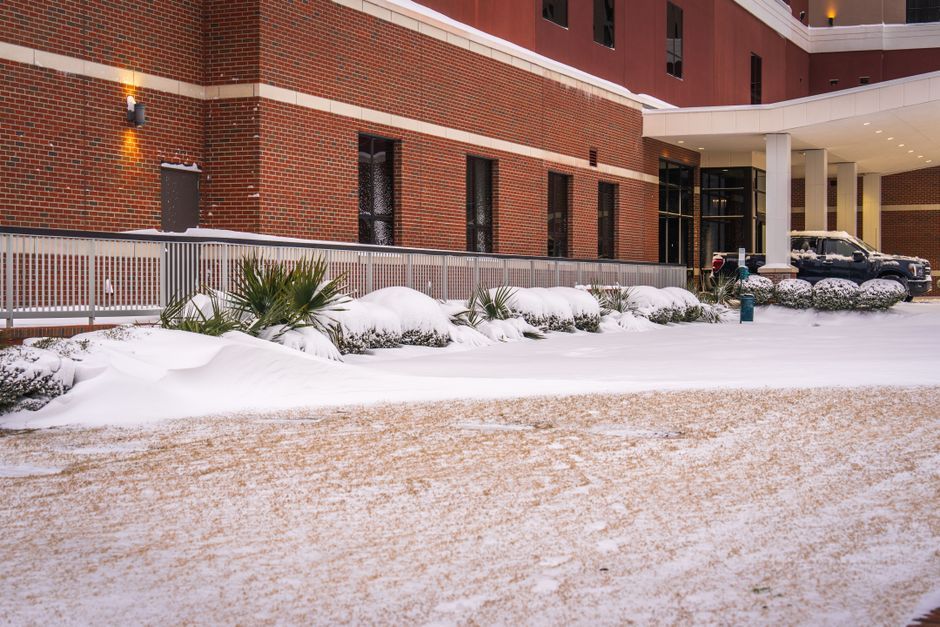
Rock salt (sodium chloride) is cheap and effective, which is why it dominates commercial use. But the U.S. Environmental Protection Agency estimates that road salt's corrosive effects on vehicles, bridges, and roads cost roughly $5 billion annually in the United States alone , and that damage extends to parking structures, sidewalks, and building foundations on private commercial property, not just public roads ( EPA, Southeast New England Program). Massachusetts alone spreads nearly half a million tons of it every winter for road maintenance.

For a property manager, that translates into accelerated spalling on parking decks, corroded rebar in structured parking, and stressed landscaping around walkways costs that show up months after the season ends and rarely get traced back to the de-icing product used. The chemical decision made in November shows up on a capital repair budget two or three years later.

Sodium Chloride: The Default, and Its Real Trade-Offs

Sodium chloride (NaCl) works by depressing the freezing point of water, and its melting action slows sharply once temperatures drop well below freezing. Its advantages are real: it's the least expensive chloride de-icer per pound and it's widely available in bulk. Its drawbacks are also well documented. The EPA notes that road salt can infiltrate surface and ground water, contaminating drinking water reservoirs and wells, and that high chloride levels are toxic to fish, aquatic insects, and amphibians ( EPA).

Penn State Extension puts the scale in perspective: the U.S. now uses roughly 20 million tons of road salt annually  about 123 pounds for every American  up from roughly 5,000 tons a year in the 1940s and 50s. Chloride becomes toxic to aquatic life above 230 mg/L, and unlike sediment or nutrients, it isn't filtered out by rain gardens or other green infrastructure because the chloride ion is repelled by soil particles rather than captured by it ( Penn State Extension, 2023). A 2014 U.S. Geological Survey study cited in the same review found that 84% of streams studied nationally had rising salinity levels, and 29% already exceeded government water-quality standards.

Calcium Chloride vs. Magnesium Chloride: The Commercial-Grade Comparison

For properties that need reliable performance in colder temperatures or want to reduce chloride load, the choice usually comes down to calcium chloride (CaCl2) or magnesium chloride (MgCl2). The two are often marketed as interchangeable "safer" alternatives to rock salt, but the manufacturer testing data tells a more specific story.

Melting Performance

CaCl2 has a much lower practical working temperature (effective ice-melting action to roughly -23°C to -32°C / -10°F to -25°F) than MgCl2, whose melting rate drops off well before it reaches its own eutectic point. In side-by-side testing referenced by deicer manufacturer Peters Chemical Company — based on a Midwest Research Institute study using Federal Highway Administration test methods — CaCl2 flake melted 29% more ice after 10 minutes and 42% more after 30 minutes than MgCl2 flake at -7°C (20°F). A separate SGS Testing Services study found the CaCl2 advantage widened to 75% more ice melted after 30 minutes at 0°F ( Peters Chemical Co., citing Midwest Research Institute and SGS Testing Services data).

Concrete and Metal Corrosion

This is where the "safer alternative" marketing gets tested against lab data. Testing by the Pittsburgh Testing Laboratory on air-entrained concrete over 500 freeze-thaw cycles (ASTM C 672-91 method) rated CaCl2 at 1.6 on a 0-5 spalling scale versus 3.1 for MgCl2 — meaning MgCl2 caused meaningfully more surface scaling. Separately, the National Association of Corrosion Engineers' Corrosion Data Survey found MgCl2 more than twice as corrosive to stainless steel and up to 10 times more corrosive to mild steel than CaCl2 ( Peters Chemical Co.). For structured parking with exposed rebar, elevator pits, or metal railings, that corrosion differential compounds every season a contract is renewed with the wrong product.

Environmental and Regulatory Load

On a dry-weight basis, MgCl2 is roughly 74% chloride versus 64% for CaCl2, and because it's a weaker de-icer, more of it has to be applied to do the same job meaning a MgCl2 program can add meaningfully more total chloride to site runoff than an equivalent CaCl2 program, even before accounting for toxicity differences in specific studies ( Peters Chemical Co.). Chloride itself, regardless of which cation it's paired with, is the pollutant regulators and watershed groups track — and it does not break down in the environment ( Penn State Extension).

Chloride Runoff and the Regulatory Exposure Commercial Properties Should Track

Chloride contamination isn't a hypothetical for commercial property owners in chloride-impaired watersheds. A 2018 study cited by Penn State Extension found that 37% of the drainage area across the contiguous United States had experienced rising salinity over the prior 50 years, concentrated in urbanized areas with heavy impervious surface coverage — exactly the profile of large commercial parking lots and campuses. Local stormwater authorities in a growing number of jurisdictions are adding chloride monitoring and load limits to commercial site permits as a direct response to this trend.

For property managers, the practical takeaway isn't to eliminate chloride de-icers — there is currently no chemical alternative that matches their cost-effectiveness at scale — but to reduce the total volume applied without sacrificing safety. This is where application method matters as much as chemical selection.

Liquid Brine and Anti-Icing: Cutting Volume Without Cutting Coverage

Pre-treating surfaces with liquid brine before a storm — rather than reactively spreading dry rock salt after snow has already bonded to pavement — is one of the more effective ways to reduce total chemical load. Penn State Extension reports that switching from dry rock salt to liquid brine application can reduce the salt actually dropped on a surface by as much as 70%, because brine spreads more evenly and begins working immediately instead of requiring traffic and time to activate ( Penn State Extension). The trade-off is that liquid brine is less effective at very low temperatures, which is why commercial operators typically pair anti-icing brine applications with a higher-performing chloride like CaCl2 reserved for deep-cold events.

How Invictus Approaches Chemical Selection Across the I-5 Corridor

Invictus doesn't default to a single chemical for every property. Deep-cold events, structured parking with exposed rebar, and properties in chloride-sensitive watersheds each call for a different product and application method — which is one reason a standard, one-size-fits-all snow removal service-level agreement often doesn't specify chemical type at all, leaving the decision to whichever crew shows up.

For pre-storm surface protection, Invictus deploys its own Easy Ice Melt liquid de-icing system, a LEED-compliant product designed to bond to surfaces and prevent ice formation before a storm arrives, staged through the on-site First Responder Units Invictus places at large commercial properties across Vancouver, Seattle, and Portland. Because those units are already on-site, ASCA-accredited crews can begin treatment the moment conditions turn, rather than waiting for a truck to leave a dispatch yard already carrying a generic bulk chemical.

That distinction matters most on properties with accessible parking and routes that must remain clear under the ADA — where the wrong chemical, or the wrong timing, creates the kind of documented gap that turns into a slip-and-fall liability claim. Every application Invictus performs — chemical type, quantity, and timing — is captured through geo-fenced service documentation, which gives property managers a defensible record of what was applied and when, not just that a truck showed up.

Properties across the region — from Vancouver, BC to Seattle to Portland — face different chloride sensitivity depending on proximity to salmon-bearing streams and stormwater infrastructure, which is one more reason chemical selection belongs in the RFP conversation, not left to whichever product a subcontractor has in stock.

FAQ: Commercial De-Icing Chemicals

  • Is calcium chloride or sodium chloride better for a commercial parking lot?

    For most surface parking lots in moderate winter conditions, sodium chloride remains the most cost-effective choice. Calcium chloride becomes the better choice in deep-cold conditions, on structured parking with exposed metal, or where faster ice penetration is a safety priority,  its higher cost is offset by needing less product to do the same job..

  • Does magnesium chloride really damage concrete more than calcium chloride?

    Testing cited by industry manufacturers and referenced in American Concrete Institute guidance indicates yes: MgCl2 has been shown to cause measurably more surface scaling on air-entrained concrete than CaCl2 in freeze-thaw testing. Neither is entirely damage-free, and proper concrete sealing remains the best defense regardless of chemical choice.

  • Can we reduce chloride use without compromising safety?

    Yes. Pre-storm liquid brine application (anti-icing) can cut the total chemical volume applied by up to 70% compared to reactive dry-salt spreading, according to Penn State Extension research, while maintaining coverage on treated surfaces.

  • Should our snow removal contract specify which de-icing chemical is used?

    It should. A contract or SLA that doesn't specify chemical type, application method, and documentation standards leaves that decision to whichever crew is dispatched — which is a gap worth closing before you sign this year's renewal.

Questions about which de-icing approach fits your property's risk profile, watershed sensitivity, or parking structure? Call Invictus at 888.459.0994 and we'll walk through the chemical and application plan for your specific site before the season starts.

Recent Posts

By Brad Caton August 13, 2026
HOA and condo association snow removal responsibility under Washington law, plus the 2026 rule that changes vendor approval. ISO SN9001 certified since 1998. Get a winter quote.
By Brad Caton August 13, 2026
Warehouse and distribution center snow removal carries OSHA duties standard retail properties don't have. See what 29 CFR 1910.22 requires, why the Kent Valley and Tacoma's warehouse corridor face unique exposure, and how Invictus keeps I-5 corridor logistics properties compliant. Request a quote.
By Brad Caton August 12, 2026
Port Coquitlam, Coquitlam, and Port Moody enforce different snow-clearing deadlines. ISO SN9001-certified Invictus explains what Tri-Cities property managers must know.
By Brad Caton August 12, 2026
Senior living and healthcare facilities face fall risks a standard snow removal SLA doesn't cover. See what a documented, higher-standard contract should require this winter.
By Brad Caton August 10, 2026
Self-performing snow removal companies own the trucks and crews — subcontracted networks don't always. Learn the 5 questions that reveal which one you're hiring, plus the insurance paper trail that proves it. Request a quote today.
Property manager and contractor reviewing a certified snow removal contract in a PNW parking lot
By Brad Caton August 4, 2026
ASCA accreditation, ISO SN9001, and CSP aren't just logos on a bid. See what each snow removal certification actually verifies and how to check them before you sign this year's contract.
Business professionals shaking hands over a signed snow removal contract, snowy lot visible outside
By Brad Caton July 30, 2026
Private equity is buying up snow and ice management companies nationwide, and SIMA's own industry data shows the trend accelerating. See what changes when a provider is PE-backed, why self-performing regional operators still win, and what to ask before you sign this year. Request a quote today.
By Brad Caton July 24, 2026
A snow removal SLA means more than trigger depth. See what SIMA's ANSI-accredited standard requires, real response-time benchmarks, and why September 1 is the real deadline. Request a quote.
By Brad Caton July 16, 2026
Commercial snow removal pricing varies by contract model, not just lot size — SIMA's own procurement guide names four fee structures the industry uses. See real 2026 rate ranges and how Invictus, the only snow removal company covering the full I-5 corridor, prices multi-property portfolios. Request a quote.
By Brad Caton July 9, 2026
Snow removal RFP proposals in? Learn the weighted scoring matrix municipalities use to separate the right vendor from the cheapest bid, plus red flags that should disqualify any proposal outright.
Show More