Construction Site Snow & Ice Management: An OSHA-Aligned Guide for Pacific Northwest GCs | Invictus Snowfighters
Brad Caton • November 11, 2026
How is job-site snow removal different from residential or completed-property snow removal?
The structure itself is the difference. A finished property has a roof and walkways engineered and rated for their final use. An active site has partial structures, unguarded edges, and heavy equipment traffic sharing the same footprint as workers on foot — which is why OSHA's struck-by and fall-hazard guidance applies with more force, not less.
A finished commercial property has walkways, a roofline, and a parking lot. An active construction site has none of that in a fixed, predictable state it has open framing, partial roof decks, scaffolding, staged material, and a crew moving through a maze of equipment and trenches. When snow and ice hit, that difference changes everything about how the hazard has to be managed.
General contractors in the Pacific Northwest already carry OSHA's general duty to plan for winter weather hazards on any job site. What most GCs haven't done is translate that duty into a site-specific plan before the first snowfall which means the plan gets improvised in the worst possible conditions, on the worst possible day, by whichever sub happens to be on-site.
This guide breaks down what OSHA actually requires for winter hazards on an active build, where a snow-loaded structure becomes a collapse risk before anyone has evaluated it, why struck-by incidents spike when plows and job-site traffic share the same footprint, and what a real snow response plan looks like when the building itself isn't finished yet.
Why an Active Job Site Isn't a "Finished Property" When Snow Hits
Every snow removal guide written for property managers assumes a stable, weatherproofed structure: a roof designed to shed load, marked walkways, lit parking areas. None of that describes a job site mid-framing. Open floor plates, unguarded edges, and partial roof decks turn ordinary snow accumulation into a fall, collapse, or struck-by exposure that a finished building doesn't have.
Scaffolding adds another layer. Ice on planking and guardrails changes the footing calculus for every worker who steps onto it, and a snow load on a scaffold platform is a different structural question than snow on solid ground. Add staged material, generators, temporary power runs, and a rotating cast of subcontractors who may not have worked a winter job before, and a site that was manageable in October becomes genuinely hazardous in a single overnight storm.
The OSHA Duty Every GC Already Has for Snow and Ice
OSHA doesn't have a construction-specific "snow removal" standard, but it is direct about the underlying obligation: employers must evaluate snow removal tasks for hazards and plan how to do the work safely, and workers should be made aware of hazards that develop unexpectedly as conditions change because layers of ice can form as temperatures drop, making surfaces more slippery than they were an hour earlier.
That evaluation duty doesn't pause for a construction site. If anything, it gets more demanding, because a GC is managing multiple trades, multiple access points, and structures that are, by definition, incomplete. OSHA's winter weather hazard guidance is written broadly enough to apply directly: assess before work starts, don't assume yesterday's safe path is still safe today, and put the plan in writing so it survives a change of crew.
Scaffolding, Roof Decks & Partial Structures: The Load Question Before Anyone Climbs
The single most important line in OSHA's winter guidance for any elevated surface is also the one most often skipped under deadline pressure: a surface weighed down by snow must be inspected by a competent person to determine whether it's structurally safe to access, because it may be at risk of collapsing. On a finished commercial roof, that's a serious call. On a partial roof deck or a scaffold platform that hasn't been engineered to carry snow load on top of its working load, it's a call that has to happen every time, not just after the first big storm of the season.
Snow cover also hides hazards a crew would otherwise see and avoid open floor penetrations, unguarded edges, and skylight rough-ins on a partially enclosed structure all disappear under a few inches of white. OSHA's guidance flags exactly this for finished rooftops: snow-covered surfaces can hide hazards like skylights that a worker can fall through. On an active build, the equivalent list is longer, and the margin for a wrong guess is smaller.
Where possible, that argues for snow removal methods that don't put a worker on the elevated surface at all the same principle OSHA recommends for finished rooftops applies with more force to a structure that hasn't been signed off yet. See our related breakdown of commercial roof snow loadfor the structural side of this question on a completed building.
Struck-By Risk: When Plow Trucks and Job-Site Traffic Mix
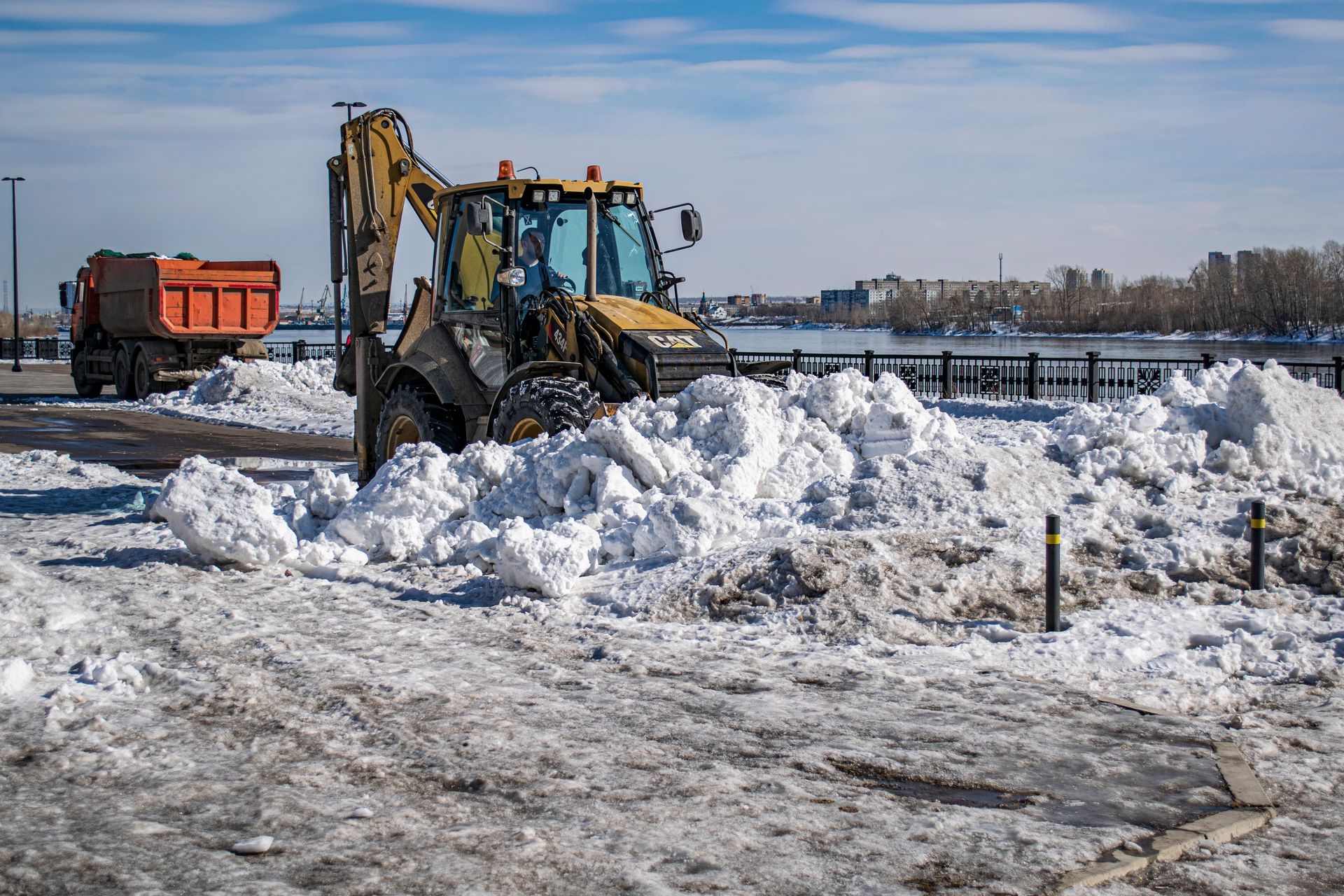
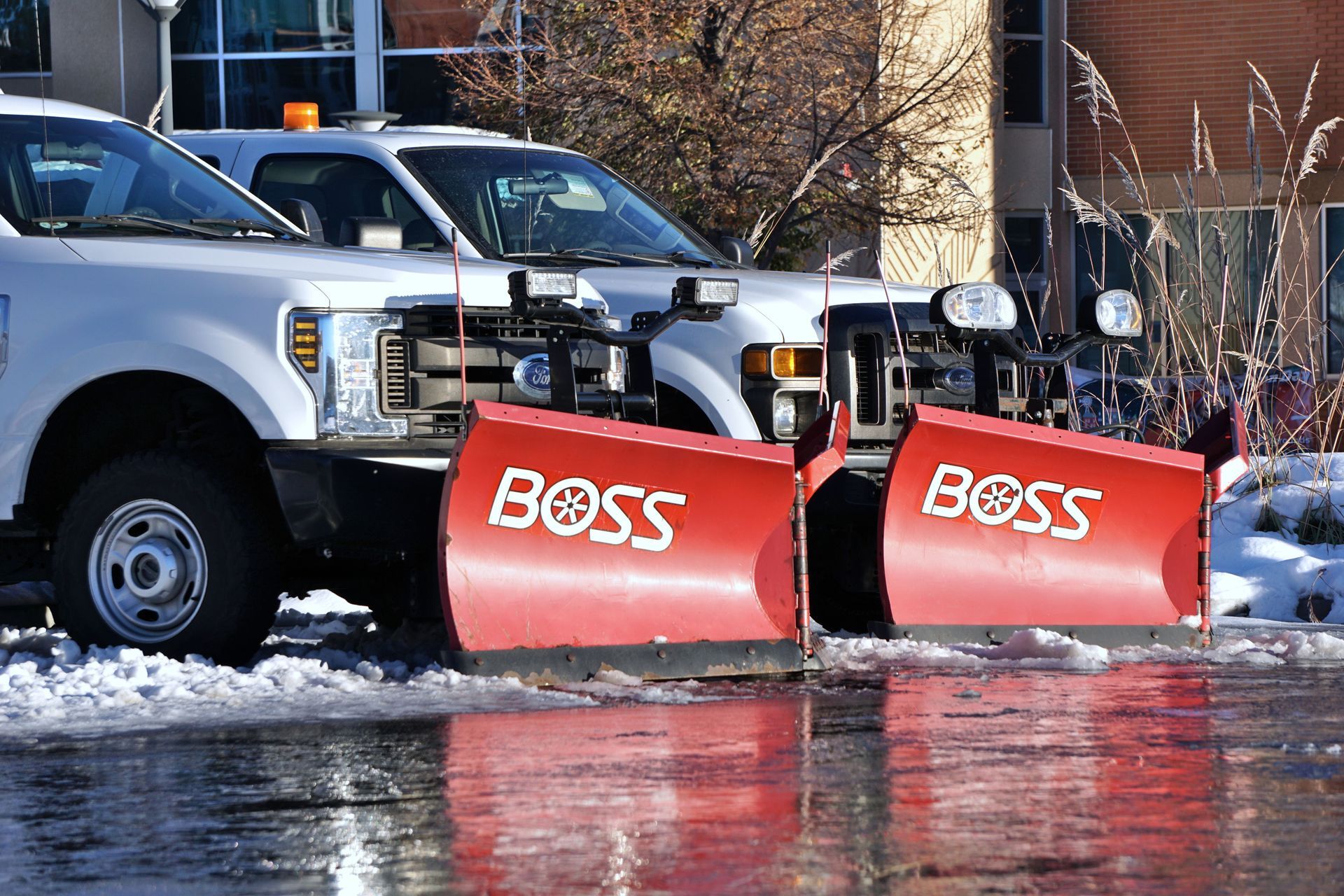
A finished parking lot has marked lanes and predictable traffic patterns. A construction site has forklifts, delivery trucks, concrete pumps, and a plow or skid-steer clearing snow through the same footprint, often before full daylight. That combination is exactly the scenario OSHA's work zone guidance is written for: workers exposed to vehicular traffic should wear high-visibility gear at all times, because drivers lose traction and control more easily on snow- or ice-covered ground, and struck-by incidents involving vehicles or mobile equipment are a leading cause of work zone injuries and fatalities.
The fix isn't complicated, but it has to be planned rather than improvised: designate and mark the snow-clearing sequence and vehicle paths before the crew arrives, require high-visibility outerwear site-wide during winter operations, and treat the plow or loader operator as a vehicle operator working a job site not a landscaper doing a quick pass before the concrete crew shows up. The same cold-exposure risks that apply to any outdoor winter crew apply here too; see our OSHA cold-stress guidance for winter crewsfor what to build into the plan.
Building a Site-Specific Snow Response Plan Before Framing Is Even Up
A property manager can write a winter plan once and reuse it every season, because the building doesn't change. A construction site changes every week. That's the case for treating the snow response plan as a living document tied to the project schedule rather than a one-time policy.
A workable plan for an active build should cover:
- Who has authority to halt elevated work when a competent person flags a snow-loaded surface as unsafe, and how that decision gets communicated to every trade on-site that day.
- A pre-cleared vehicle and pedestrian path plan, updated as the site layout changes with each construction phase.
- High-visibility gear as a standing requirement for anyone on foot during winter operations, not just during active snowfall.
- A named point of contact for snow and ice response who isn't also trying to run the framing crew that day.
- A pre-storm deployment trigger, so ice-prevention treatment goes down before the storm rather than after the first fall.
None of that requires a dedicated snow removal contractor to be effective but it requires someone to own it, in writing, before the first snow event of the season, not during it.
Why a Dedicated First Responder Unit Outperforms a Sub's Side Job
On most job sites, snow clearing falls to whichever sub has a truck with a plow attachment, worked in between their actual scope. That arrangement is exactly what leads to the failure modes above: no competent-person structural check, no coordinated traffic plan, response measured in hours instead of minutes because the plow truck is busy on another job.
Invictus treats winter response as the primary service, not a side job that's the difference behind what our founder calls "first responder" work: people are hurt in snow and ice situations, and a site that treats a storm like a landscaping inconvenience is the site where that happens. Our LEED-compliant Easy Ice Melt program and on-site First Responder Units exist for exactly this gap — equipment staged before the storm, not sourced after it.
For GCs running multiple active sites across the I-5 corridor, that also means one point of contact instead of coordinating separate ad hoc plow arrangements per site the same economy-of-scale case we've made for multi-property portfoliosapplies just as directly to a GC managing several builds through the same winter. And because documentation matters as much on an active build as it does on a finished property, the same geo-fenced service records that hold up in a slip-and-fall claimapply here too useful if a struck-by or fall incident ever needs to be reconstructed.
Construction Site Snow Removal: Frequently Asked Questions
Does OSHA require a specific snow-load limit before construction workers can access a roof deck or scaffold?
OSHA doesn't publish a single universal snow-load number — it requires that a competent person inspect any snow-weighed surface and determine whether it's structurally safe to access before anyone does. On an active build, that determination has to account for the structure's incomplete engineering, not just its finished-building rating.
Who is responsible for snow and ice removal on a construction site — the GC or the subcontractors?
OSHA places the duty to evaluate and plan for winter weather hazards on the employer controlling the work, which on most sites is the general contractor. Individual subs are responsible for their own crews' safe practices, but the site-wide plan, traffic routing, access decisions, and high-visibility requirements is a GC-level responsibility.
Can snow removal happen on an active job site without a dedicated snow contractor?
Yes, but it requires the same discipline a dedicated contractor brings: a named owner of the decision, a written plan, and equipment staged before the storm rather than sourced after it. Most gaps show up when that ownership defaults to "whoever has a plow attachment that day."
How is job-site snow removal different from residential or completed-property snow removal?
The structure itself is the difference. A finished property has a roof and walkways engineered and rated for their final use. An active site has partial structures, unguarded edges, and heavy equipment traffic sharing the same footprint as workers on foot — which is why OSHA's struck-by and fall-hazard guidance applies with more force, not less.
Recent Posts