
Residential Snow Removal in the Pacific Northwest: Why Waiting Until the First Snowfall Costs You
Brad Caton • August 20, 2026
Every winter, homeowners across the Pacific Northwest wait for the first real snowfall before they think about clearing a driveway. By then, it's already too late to get on a professional crew's schedule and, in some cities, it's already too late to avoid a fine. Residential snow removal isn't just about convenience. It's about a legal obligation many homeowners don't know they have, a genuine injury risk on your own front steps, and a booking window that closes months before the snow does.
Invictus Snowfighters has spent more than 30 years managing snow and ice across the I-5 corridor, from Vancouver to Seattle to Portland. Most of what we've built the equipment-matched contracts, the ISO SN9001 certification, the first responder mindset grew out of commercial properties. But the same reliability problem homeowners face is real, and it's worth understanding before winter arrives, not during it.
Why Snow and Ice on Your Property Is More Than an Inconvenience
The Centers for Disease Control and Prevention is blunt about this: "Walking on ice is extremely dangerous. Many injuries related to cold weather happen from falls on ice-covered sidewalks, steps, driveways, and porches." The agency's winter storm safety guidance recommends keeping steps and walkways as free of ice as possible using rock salt or another chemical de-icing compound, with sand as a supplemental option to reduce slip risk.
That's not abstract advice. A driveway, front walkway, and porch are exactly the surfaces homeowners are least likely to treat consistently they're outside the daily commute, easy to put off until "later," and the first place a delivery driver, a visiting relative, or your own kids will walk without thinking twice about footing.
The Legal Risk Most Pacific Northwest Homeowners Don't Know About
In Washington State, cities and counties have clear authority to require homeowners to clear snow and ice from the sidewalks adjacent to their property. According to MRSC (the Municipal Research and Services Center, a nonprofit that advises Washington local governments), a county or city may pass an ordinance requiring property owners to remove snow and ice from sidewalks next to their homes, a power rooted in Article 11, Section 11 of the Washington State Constitution. That authority was affirmed as far back as a 1956 Washington Attorney General opinion, which concluded that a city may not only require snow removal from abutting sidewalks but may impose a lien against the property if the owner fails to comply.
Washington courts have also drawn a line on liability: under the "natural accumulation" doctrine from cases like Calder v. Walla Walla and Nelson v. Tacoma , a municipality generally isn't liable for injuries from ordinary snow and ice buildup but that same reasoning is exactly why the responsibility for the sidewalk in front of your house often falls back on you, the homeowner, once your city has an ordinance on the books. Seattle, Vancouver, and Portland each handle this differently in their own municipal code; we've broken down what "reasonable time" and "timely manner" actually mean for Seattle homeowners, what's required under Vancouver's snow removal bylaw, and the specifics of Portland's legal obligations in separate guides the point here is simpler: if you've never checked, summer, before you need the answer, is the time to check.
Why Booking Residential Snow Removal in Summer Beats Waiting for the First Storm
The same capacity problem that drives our commercial contract timing applies just as directly to homeowners, for a plain operational reason: we don't overcommit equipment or crews. Every contract, residential or commercial, gets dedicated capacity we've confirmed we can actually deliver on before we agree to it. That's a deliberate constraint, not a marketing line — it's the same lesson every snow removal operator eventually learns the hard way, when a storm hits and there simply isn't enough equipment or manpower to be in two places at once.
What that means for a homeowner is straightforward: the earlier you're on our books, the more certain your coverage is when the first real storm rolls through the I-5 corridor. Homeowners who call after the first snowfall are competing for whatever capacity is left over once existing contracts commercial and residential are already served. We've written separately for property managers about why summer is the time to lock in a commercial contract; the underlying capacity math is identical for a single-family driveway.
DIY Driveway and Walkway Clearing vs. Professional Residential Service
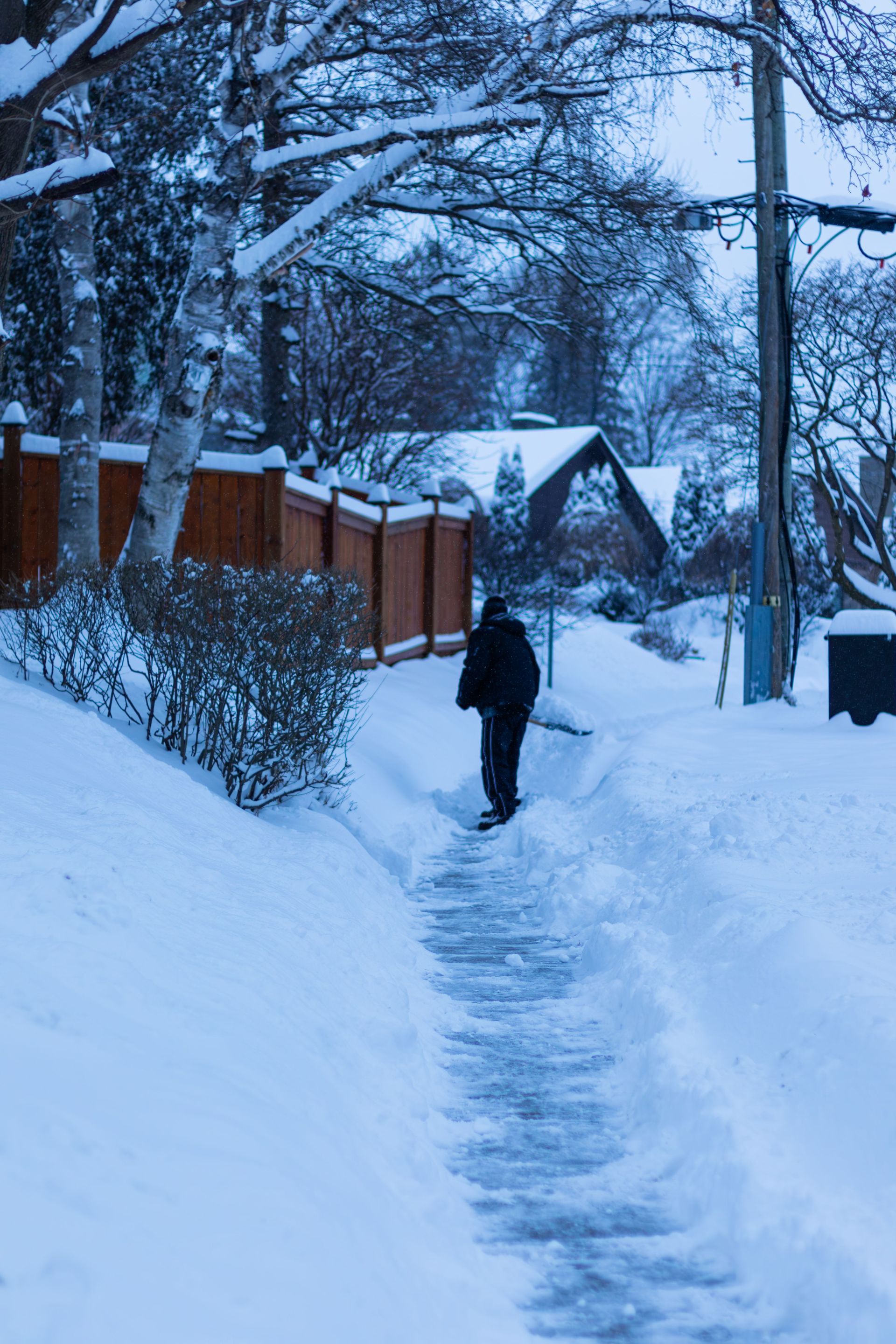
Shoveling and salting your own driveway works fine for a light dusting. It becomes a different problem during a multi-day system, black ice overnight, or when you're traveling and the property sits untreated. A few practical differences:
- Consistency during multi-day events. A single homeowner with a shovel can maintain one clearing cycle a day at best. A professional crew on a route can return multiple times as conditions change.
- Ice prevention versus ice removal. Pre-treating a surface before a storm bonds a de-icing agent to the surface and stops ice from forming in the first place, which is a fundamentally easier problem than chipping away ice after it's already bonded to concrete.
- What happens when you're not home. Winter storms don't wait for you to be back from a trip. A contracted service clears the property whether or not you're there to do it yourself.
None of this means DIY clearing is wrong for every homeowner for many properties in milder years, it's genuinely sufficient. But it's worth being honest with yourself about which category your household falls into before the first storm makes the decision for you.
What to Look for in a Residential Snow Removal Company
The same standards that matter for a commercial property manager evaluating a vendor apply, in a smaller way, to a homeowner:
- Real equipment capacity, not just a truck with a plow blade bolted on. Ask whether the company procures equipment specifically for the volume of contracts it takes on, or whether it's stretched thin the moment more than one property needs service at once.
- A plan for ice, not just snow. Snow is visible and shovelable. Ice, especially black ice on a driveway apron or front steps, is the more dangerous and less obvious hazard, and it requires a pre-treatment plan rather than a reactive one.
- Actual local presence. A company that only serves a single neighborhood may not have the depth to respond during a major regional event, while a company that only sources labor and equipment nationally may not know your specific streets, driveways, or local conditions.
How Invictus Protects Pacific Northwest Homes This Winter
Invictus Snowfighters is the only ISO SN9001 certified snow and ice management company operating boots-on-the-ground across the full I-5 corridor, from Vancouver, BC through Seattle, WA to Portland, OR. For residential customers, that means the same operational backbone we built for commercial and government properties — equipment-matched service commitments, LEED-compliant Easy Ice Melt that bonds to surfaces before ice forms, and 24/7 emergency availability applied to a single driveway and walkway instead of a multi-acre commercial lot.
The same liability logic we walk property managers through in our guide to slip-and-fall liability for commercial properties applies at a household scale too: a cleared, documented, consistently treated walkway is simply safer for the people who use it, whether that's a tenant's employee or your own family and visitors.
Frequently Asked Questions About Residential Snow Removal
Am I legally required to clear snow and ice from my sidewalk?
In many Pacific Northwest cities, yes. Washington cities and counties have constitutional authority to require homeowners to clear sidewalks adjacent to their property, and can impose a lien for non-compliance. The specifics vary by city, so check your local ordinance directly rather than assuming.
How is residential service different from commercial snow removal?
The core standards equipment-matched capacity, pre-storm ice prevention, 24/7 response are the same. The scope is simply smaller: a driveway, walkway, and porch instead of a parking lot or commercial campus.
How early should I book residential snow removal for winter?
Before the first storm, ideally over the summer or early fall. Because contracts are matched to confirmed equipment and crew capacity, homeowners who wait until the first snowfall are competing for whatever capacity is left after existing contracts are served.
Is DIY shoveling and salting good enough?
For light, occasional snow, often yes. For multi-day storms, black ice, or when you travel during winter, a professional service closes the gap between what you can realistically keep up with and what the property actually needs.
Does Invictus serve homeowners across the whole region, or just commercial clients?
Both. Invictus provides residential snow removal alongside its commercial and government work across Vancouver, Seattle, Portland, and the surrounding I-5 corridor communities.
If your driveway, walkway, or front steps have been an afterthought in past winters, summer is the window to fix that before the first storm makes the decision for you. Get in touch with Invictus to lock in equipment-matched residential coverage before the schedule fills.
Recent Posts