
Commercial Parking Lot Snow Storage Planning: A Pre-Winter Guide | Invictus Snowfighters

Brad Caton • August 25, 2026

Share this article

By the time the first storm hits, your snow storage plan should already be finished. Most property managers think about snow removal as a winter problem: who's plowing, how fast they respond, what the contract says about response time. Almost nobody asks where the snow is actually going to go once it's off the pavement. That question gets answered badly, in the middle of a storm, by whoever's driving the plow that shift and a badly-answered version of it costs parking spaces, drainage, and in the worst case, a liability claim. This is a planning problem, and August is a better time to solve it than January.

Why Snow Storage Planning Belongs on Your Summer Punch List

Snow storage is the part of a winter service plan that almost never makes it into the contract conversation. Property managers negotiate response times, service levels, and pricing, then leave "where does the plowed snow actually go" to be improvised on-site during the first real storm. By then, the parking lot is already full, tenants are already circling for spaces, and whoever is running the plow is making a permanent decision about traffic flow and drainage in about four seconds.

Industrial site design engineers treat this differently, because they're planning fixed infrastructure rather than reacting to weather. Kimley-Horn, a national civil engineering firm, flags snow storage capacity and drainage as a design requirement for any site in a cold-climate region — not an operational afterthought handled after the fact. A commercial property doesn't need to re-pave anything to borrow that logic. It needs a plan, made before the snow falls, for where it's allowed to pile up.

For multi-property portfolios spanning Vancouver, Seattle, and Portland, this is also the point in the year when it's still possible to walk every site, mark storage zones, and hand that plan to whoever is onboarding as your vendor before the first snowfall — instead of hoping the crew improvises something reasonable.

How Your Parking Lot Layout Decides Where the Snow Can Go

Every parking lot has a different answer to where snow can go, because the answer depends entirely on how the lot is actually used. A property with a handful of reserved executive spaces and light daytime traffic has more flexibility than a retail lot that needs every space open by 9 a.m. A site with one entrance has fewer safe places to stage a pile than one with multiple points of ingress and egress.

The factors that actually decide where snow can be stored on a given site include:

  • Parking density and how much of the lot is realistically full at any given time
  • Where vehicles enter and exit, and whether piling snow near those points blocks sightlines
  • Loading docks, service areas, and delivery routes that can't be obstructed
  • Pedestrian walkways and building entrances, where a pile becomes a walking hazard
  • Drainage structures and catch basins, which shouldn't be buried under a pile
  • Emergency vehicle access, which has to stay clear regardless of how much snow has fallen

None of this is guesswork once it's mapped. A site walk before the season identifies two or three designated storage zones usually underused corners, medians, or landscaped buffers that preserve parking capacity and keep traffic moving even after repeated storms. Without that map, the default behavior is to push snow to whatever's closest, which is usually the worst possible spot.

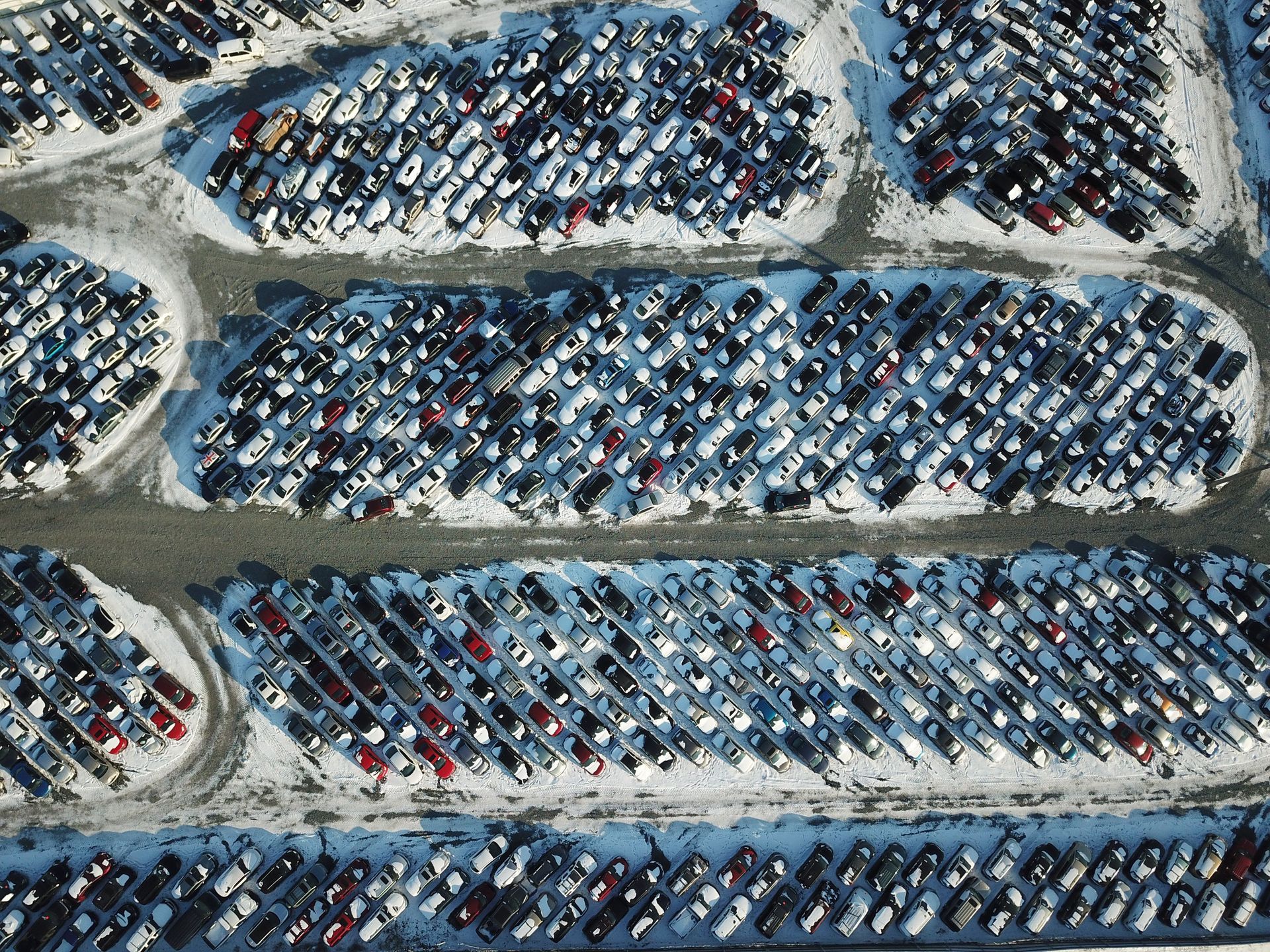
Aerial view of rows of parked cars in a crowded lot with dirt lanes between them

The Drainage Problem Snow Piles Create

A snow pile in the wrong spot doesn't just take up space it creates a second problem once temperatures start swinging above and below freezing. As a pile melts, that water has to go somewhere. If it's positioned near a catch basin, a low point in the pavement, or a walkway, the meltwater refreezes overnight and turns a parking lot corner into an ice sheet. That's a separate hazard from the original storm, and it's one your service contract may not even account for, since it shows up on clear days.

Great Lakes Snow Systems, a commercial snow and ice contractor, describes this as one of the most underestimated costs of poor pile placement: piles positioned near building access points or low-lying pavement contribute to recurring ice formation long after the storm that created them has passed. In many cases, the meltwater problem does more damage to a property's operations over a season than the temporary loss of a few parking spaces.

This is closely related to a separate compliance issue: in the Pacific Northwest, snow and ice meltwater is treated as regulated stormwater in several jurisdictions. If your property is subject to a stormwater permit, where you're storing snow isn't just an operations question — see our guide to stormwater compliance for snow removal for what that actually requires.

When a Snow Pile Becomes a Liability, Not Just an Eyesore

A pile that blocks sightlines at an intersection, narrows a walkway to single-file, or sits close enough to a building entrance to melt and refreeze on the sidewalk isn't just an aesthetic problem. It's the kind of condition that shows up in a slip-and-fall claim, and it's one property managers rarely think to ask their snow vendor about directly.

The questions worth asking before the season starts: Does the plan account for sightlines at every entrance and intersection on the property? Are piles kept clear of pedestrian routes, not just vehicle lanes? Is there a process for relocating a pile once it starts to interfere with visibility or access, rather than just letting it grow in place? A vendor who can answer these with a specific plan, not a general assurance, is doing the planning work before the storm instead of during it.

Documentation matters here too. If an incident does happen, what actually holds up is a timestamped, geo-fenced record of where snow was placed and when the lot was last serviced — not a general claim that the property "was plowed." We cover what that kind of documentation actually needs to look like in more detail separately.

Planning for Relocation Before You Run Out of Storage Space

Designated storage zones work until they don't. After several storms in a row, or one heavy event, on-site zones can fill to capacity. At that point, the plan needs a second stage: where does snow go once the primary storage areas are full? Waiting until that moment to figure it out means snow gets pushed into active parking spaces or drive lanes by default, because there's nowhere else for it to go.

A relocation plan a secondary on-site zone, or an arrangement to haul snow off-site once volume crosses a set threshold is the difference between a property that stays functional through a multi-storm stretch and one that loses capacity with every additional inch. This is also where portfolio-level planning pays off: a vendor servicing several properties in the same corridor can move equipment and hauling capacity to whichever site is closest to its storage limit, rather than each property fending for itself.

How Invictus Builds a Site-Specific Snow Storage Plan

This is the part of winter service that gets skipped when a vendor is treating snow removal as a side service instead of a specialty. Invictus was built the other way. After years of learning sometimes the hard way what happens when equipment and planning don't match the site, the company's approach is to map storage zones, drainage risk, and relocation triggers before signing a contract, not after the first storm exposes the gaps.

Every property gets a walk-through that identifies primary and secondary storage zones, flags drainage and sightline risk, and gets documented in the service plan not left to whoever's on shift that night. Combined with Easy Ice Melt pre-treatment to reduce how much ice forms in the first place, and geo-fenced, timestamped service records for every visit, the goal is a property that stays functional and defensible through the whole season, not just clear after the first pass.

For portfolios spanning multiple properties across the I-5 corridor, that planning happens at the portfolio level too, so storage capacity and equipment can flex to whichever site needs it most during a heavy storm.

Frequently Asked Questions

  • When should snow storage planning happen?

    Before the season starts. A site walk in late summer or early fall, while the lot is empty of snow and easy to assess, gives enough time to mark storage zones and share the plan with tenants and staff before the first storm. 


  • Who decides where snow gets piled on a commercial property?

    In practice, it's often whoever is operating the plow that shift, unless a plan has been documented in advance. That default leads to snow being pushed to the nearest open space rather than the safest one. 

  • Can a poorly placed snow pile create liability beyond the storm itself?

    Yes. Piles that block sightlines, narrow walkways, or melt onto pedestrian routes can create hazards on clear days, well after the original snowfall, particularly when meltwater refreezes overnight. 

  • What happens when on-site storage runs out during a heavy snow year?

    Without a relocation plan, snow typically gets pushed into active parking or drive lanes, reducing usable space. A pre-arranged relocation or off-site hauling plan avoids that outcome. 

Snow storage planning is one of the easiest parts of a winter service plan to skip, because it doesn't show up as a line item and nothing goes wrong until it does. The properties that get through a heavy snow season without losing parking capacity, without a drainage mess, and without a liability incident are almost always the ones where somebody mapped it out before the season started. If that hasn't happened for your property yet, this is the time of year to do it, not November.

Recent Posts

By Brad Caton August 27, 2026
Commercial snow removal gets expensive and unpredictable when a portfolio is split across five vendors. See what real economy-of-scale consolidation saves, and what to vet first. Request a quote from Invictus.

By Brad Caton August 27, 2026
Snow removal invoice disputes usually mean one thing: no verifiable service record. See how GPS-verified documentation protects PNW portfolios. ISO SN9001-certified. Get a quote.
By Brad Caton August 27, 2026
BC's Occupiers Liability Act sets a duty of care separate from your city's snow removal bylaw. See what BC courts have ruled, what reasonable care requires, and get a pre-winter checklist from ISO SN9001-certified Invictus Snowfighters. Request a quote.

By Brad Caton August 26, 2026
Snow removal documentation is what protects your property when a slip-and-fall claim lands months later. See what evidence actually holds up, and how ISO SN9001-certified Invictus timestamps and photographs every service call across the I-5 corridor. Request a quote.

By Brad Caton August 26, 2026
OSHA names snow cleanup crews among workers most at risk for cold stress. See what to ask your vendor about crew rotation, and how ISO SN9001-certified Invictus builds staffing depth into severe-weather coverage across the I-5 corridor. Request a quote.
By Brad Caton August 25, 2026
Snow removal contract renewal for winter 2026-27 should factor in NOAA's July update: an 81% chance of a record-strength El Niño. See why. Request a quote today.
By Brad Caton August 24, 2026
Snow and ice removal counts as regulated stormwater in the Pacific Northwest. See what NPDES and Washington's Construction Stormwater Permit require, and how ISO SN9001-certified Invictus keeps your property compliant. Request a quote.

By Brad Caton August 24, 2026
What can you enforce when a snow removal contractor breaches your SLA? A property manager's guide to liquidated damages, force majeure, and documentation, from ISO-certified Invictus Snowfighters.

By Brad Caton August 21, 2026
School and university snow removal liability isn't ordinary premises law. Learn what governmental immunity covers, where courts draw the line for enrolled students, and how documentation protects your campus.

By Brad Caton August 21, 2026
Parking garage de-icing salt slowly corrodes reinforced concrete. See what engineering research says about safer de-icers for PNW structures. Get a quote.
Show More